| The Stateman |
|
| The Telegraph |
|
| Hindustan Times |
|
| Others |
|
| External Pages |
|
| |
| |
|
The Statesman – Sport & Leisure 14 August 2002.
ANNAPURNA BASE CAMP -- Braving the odds
The trail to the Anapurna Base Camp leads to a natural Himalayan amphitheatre, awesome in the vista it presents of an almost 360-degree panorama of snowy peaks. But the road to such splendor is difficult and dangerous, cautions Rangan Datta.
Along with its sister peaks belonging to the Annapurna range, Machhapuchare (Fish Tail) towers over the popular Napelese lakeside town of Pokhara, an irresistible lure to climbers like me. At the end of a five day trek lies the base of this majestic mountains. The trail follows the course of the Modi Khola (khola means river), opening up into a open amphitheatre as it were, so that its width three miles. Rising directly from its walls are nine peaks, each over 6,000 meters high, all draped in a frozen cascade of glacial ice. Standing like sentinels on either side of the entrance to this amphitheatre are Machhapuchare ad the Christmas-cake summit of Hiunchuli. A razor-edged ice ridge connects Hiunchuli to the Annapurna South peak, joined in its turn, by a wall of broken ice to the Varaha Sikhar Peak (also known as Fang) and further on, to the huge south face of Annapurna I, the goal of many a seasoned climbers.Beyond the latter, the wall breaks up into an entire series of ridges and peaks that jut out from it. The remaining part of the wall curves to embrace Machhapuchare, circumscribing an entire circle that ensures an 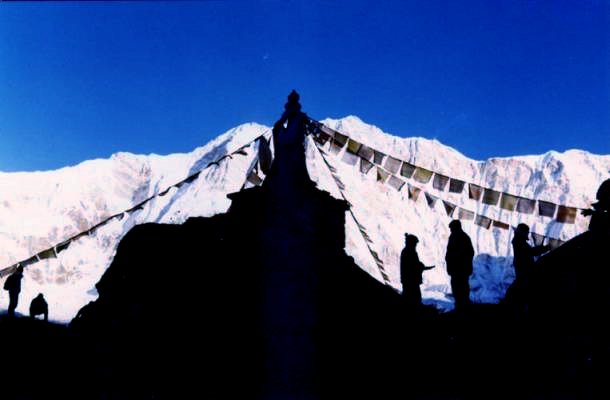 almost 360-degree panorama of snow peaks. almost 360-degree panorama of snow peaks.
In 1970, Chris Bonington and his party used the amphitheatre as a base camp to conquer Annapurna-I via its south face. Today, the amphitheatre is part of the Annapurna Sanctuary, covered by the Annapurna Conservation Area Project which is responsible for the development of the area. Trekkers’ fees are channelised by officials engaged in this project to the local inhabitants for the growth of the region.
My own journey to this dreamland began on a mid-October evening in Kolkata, when I boarded a train for New Jalpaiguri. A ride from there to Bagdogra and subsequent bus journey to the Nepal border seemed smooth and hassle-free. But I knew, well enough, that this was the easy part. Formalities completed at the border, I took an overnight bus from Kakarbita, which took me past Pokhara to Nayapool, the starting point of my trek. A brief rest I was off to Birethanti, the gateway to the ACAP. Paying my entry fee Rs. 400 in Nepali currency I continued on my way. The fatigue from the long bus journey still persisted, helped in no way by the heat and humidity of the low-altitude terrain.
The lunch break at Shiuli Bazar revived me somewhat and I followed the trail past Kimche village and towards my day’s target: Gandruk, the head quarters of ACAP. Equiped with a number of first-class hotels and a telephone booth with ISD facilities, this large Gurung village is the ideal halting point for those far from home.
I awoke, the next morning, to a clear day and stunning view of Annapurna South, Hiunchuli and Machapuchare, the trio of peaks rising haughtily skywards and dwarfing the village by their sheer size. I have already set my self the day’s goal: Chomrong, another large village located almost at the same altitude. The route to my destination was, however, as hard on the lungs as on the legs with its series of ascents and descents.
A short while later, I reached a village called Komrong. From this point onwards, the trail plunged straight down to Kimrung Khola gorge across which lay Kimrung village Halting briefly for lunch, I was soon on my way to Chomrong. The trail was very steep and the heat and humidity were killing. By 3’o clock I was trudging into Chomrong, where a hot solar shower recharged my batteries like a high-voltage current.
I was greeted, the next morning by a superb spectacle – rows of mountain peaks but I had no time to stand and stare. A considerable distance had to be covered that day and I had to start out early. The going was tough, beginning with a terrifyingly steep decent down a stone stairway to the Chomrong Khola, followed by a precarious crossing over a hanging bridge. Having reached the other end, I followed the trail up a sharp incline that cut through a bamboo forest. With my heavy backpack hindering all the way, I was quite overcome by the sight of “civilization” a cluster of hotels aptly named Bamboo. 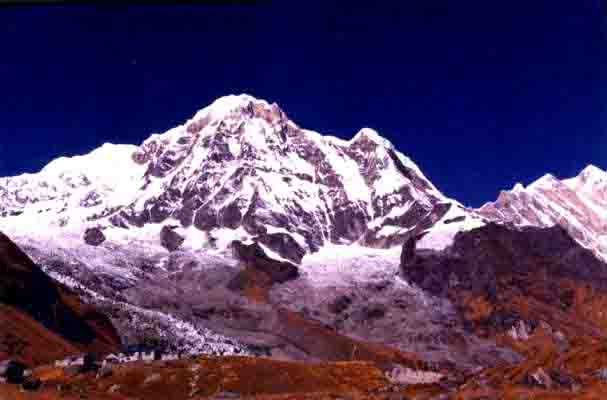
Lunch at Bamboo over, I was detained by a smart shower that no signs of letting up. Left with little choice, I continued on my way under weeping skies, my feet slithering in the mud and trying, often quite unsuccessfully, to retain a steady grip. Reaching Doban, my resolve to carry on abandoned me and I decided to call it a day, although I was now 24 hours behind schedule.
As is the way with hill country, the skies cleared the next morning. I knew I had only a short distance to cover that day, but the trek involved a steep climb. Making my way doggedly up the incline, I reached a cluster of hotels at a place called Himalaya. Skirting past it, the trail continued to rise sharply and led to Hinko Cave, a large overhang designed by nature to shelter a number of people in inclement weather. Unfortuately the mouth of the cave entrance had been sealed off, forcing trekkers to seek shelter in the lodges.
Leaving Hinko behind, I negotiated my way gingerly through a dangerous rock fall zone to entered Deaurali, a cluster of four hotels serving the needs of trekkers from across the world. Here, and not for the first time since I began traveling in the region, I faced commercialization in its worst form. Being a solo trekker without a guide or porter, I was refused a room, even though I was always ready to share it with another trekker or alternatively, pay the entire amount for a double bedroom. It took me much pleading on my part, before I was given a room.
An overcast sky greeted me the following morning, not a auspicious beginning for the final leg of my journey to the Annapurna Base Camp. The route was a short, but sharply inclined. By the afternoon, I arrived at the Machapuchare Base Camp. This was, apparently, the vantage point for beautiful views of mountain and sky. But right now the clouds regained supreme. Pausing for a short rest, I carried on doggedly. The trail followed the course of Modi Khola, a mere trickle at this point and although at a given moment, the lodges of Annapurna come into view, I knew I had miles to go before I could call it a day. Meanwhile, it started to snow but before I could give up in despair, I had reached my destination.
That, however, was not the end of my problems. Being a single trekker, proved yet again, to be a curse. For no lodge owner was prepared to accommodate me. Finally, one of them deigned to allow me the use of the storeroom attached to trekkers’ hut. By then, it had stopped snowing and I readily joined some locals in a game of volley ball. But the thin air at an altitude of 4000 metres, left me gasping for breath after my exertions.
Giving up, I fled to the warmth of the dinning hall. Catering as they do to an international clientele, lodges serve excellent food including delicacies like pizzas, fried rice, puddings and custards, but the prices charged are as steep as the trails leading up to them. A plate of rice and lentils, for example, costs (in Nepali currency) Rs 160 (Rs. 100 Indian currency is equilavent to Rs160 in local money), a cold drink Rs100! Before going to bed, I could only pray that the sky clears swiftly, releasing me from the necessity of staying at the lodge.
A delightful sight awaited me the next morning. The sun had yet to rise, but the sky was sparkling clear and everyone was out enjoying the fine weather. Swathed in thick woollens and equipped with a camera I joined the others. On a ridge here stood a Buddhist-style memorial to the mountaineers who have died in their quest to conquer the mighty peaks. A walk along the ridge, which dropped a few hundred feet into the moraine of South Annapurna Glacier, brought me closer to Annapurna-I. Avalanches came crushing down the glacier at frequent intervals and the view from the top of the ridge was simply mind-blowing.
As the sun rose behind the Machhapuchare’s spire, its rays hitting the glacier, the frequency of avalanches increased. I lingered long after sunrise, gazing in the awe at a sight I felt I was specially blessed to enjoy.
It was time to go back to my own world and reality. I packed my bags and made my way down from the heights. The skies remained clear all the way and the mountains were revealed to me in all their glory. Was it to remind me of all that I would be missing once I was home? Perhaps. But it left me with no regrets. |