Next weekend you can be at ... Chandraketugarh
The remains of a temple constructed during the times of legendary mathematicians Mihir and Khana, 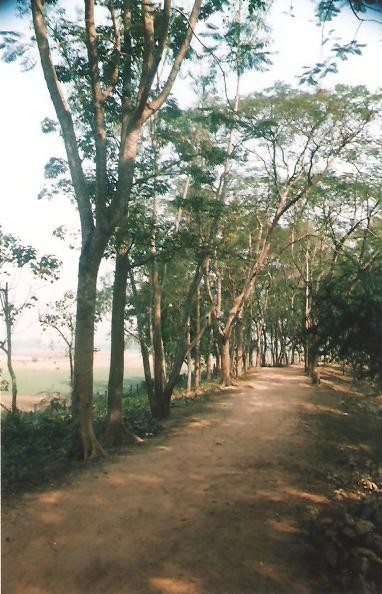 a fort built by the mythical king Chandraketu that was hidden under a mound for centuries and a mosque that could actually have been a Buddhist stupa ? if myth and mystery fascinate you and history gets you going, pack your bags and head for Chandraketugarh. You will hardly find a better place to spend a spring day. a fort built by the mythical king Chandraketu that was hidden under a mound for centuries and a mosque that could actually have been a Buddhist stupa ? if myth and mystery fascinate you and history gets you going, pack your bags and head for Chandraketugarh. You will hardly find a better place to spend a spring day.
About 50 km from Calcutta, Chandraketugarh can be reached by road, via Barasat, in approximately two hours. Your first stop could be Barachampa where you walk over to Khanamihirer Dhipi. The mound has been dug up to reveal the remains of an ancient temple.
According to Archaeological Survey of India (ASI), which carried out the excavation, the temple was part of a prosperous urban settlement called Chandraketugarh, which flourished between 4th Century BC and 12th Century AD.
This remarkable civilization spanned at least six eras, starting from that of the pre-Mauryans and ending with the Pala period.
The temple, believed to have been constructed by the Palas, is the most valuable archaeological find of the region. Almost nothing is left of the polygonal structure connected to a square vestibule. The roof had collapsed long ago and all that remains are the walls and a flight of stairs. The grandeur of the temple can be gauged from the remnants of the 4-ft thick walls.
Bid farewell to the temple to head for the Chandraketugarh ruins. As you leave the crowded Barachampa behind, lush green fields will greet you on either side of the road. Soon, however, the metal road merges into a mud track. Follow the trail for half-an-hour to find yourself at Chandraketugarh.
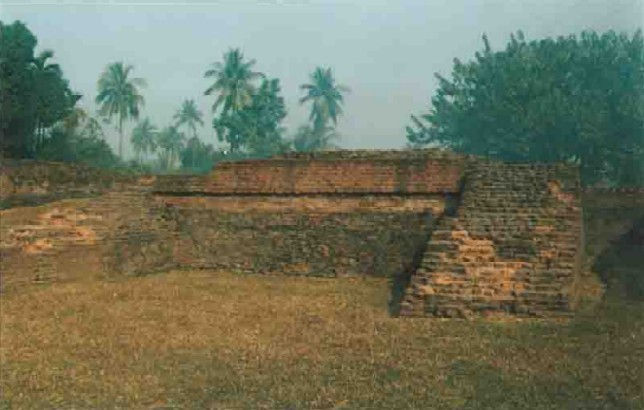 A board put up by ASI declares it a monument of national importance, although nothing much has been done at the site after the initial excavation of 1956-57. There?s a small field in front of the ruins, which is ideal for an impromptu picnic. A board put up by ASI declares it a monument of national importance, although nothing much has been done at the site after the initial excavation of 1956-57. There?s a small field in front of the ruins, which is ideal for an impromptu picnic.
Get back to the main road to take a bus to Haroa, home of the legendary Pir Gorachand. According to local lore, pleased with Gorachand?s devotion, the Sun God ordered him to build a mosque here. But there was one condition ? the mosque had to be built in His absence. In other words, the construction work had to be completed between one sunset and the next sunrise. Gorachand and his followers raced against time to please the god. But as they were finishing fixing the roof, a crow cawed, signalling daybreak. Gorachand had to abandon the work. Even now, the mosque stands incomplete.
Historians, alas, have come up with more rational theories of the mosque?s construction! Rakhaldas Banerjee, of Mohenjodaro fame, claimed that a Buddhist stupa was constructed at the site during the time of Jesus Christ. He maintained that almost 1,300 years later, an attempt was made to construct a mosque over the ruins of the stupa.
Take a cycle-van from the Haroa bus stop to Lal Masjid. Surrounded by ponds on three sides, a 30-ft red wall and a banyan tree are all that remain of the structure.
 The giant tree has spread its roots through the length of the wall, which is on the brink of collapse. Its distinctive red colour differs considerably from the hue of the mound of bricks on which it stands. The giant tree has spread its roots through the length of the wall, which is on the brink of collapse. Its distinctive red colour differs considerably from the hue of the mound of bricks on which it stands.
Everywhere in Haroa, the legend of Gorachand lives on. From the bus driver to the stall-owner, everyone offers a different version of the exploits of the Pir.
Stop over at the darga of Pir Gorachand, near the bus stand, before starting back for the city.
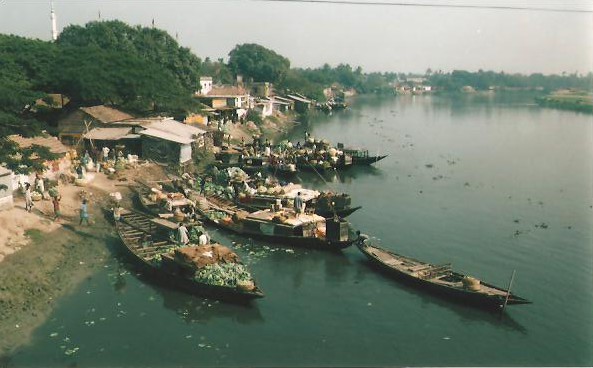
You can also undertake a trip to the Vidyadhari Bridge for a grand view of the river.
Going
Buses are available at regular intervals from Esplanade and Ultadanga. The fare to Barachampa is about Rs 20. Take a Trekker or a bus to Haroa from Barachampa. The ticket costs about Rs 10
Touring
Both Barachampa and Haroa have a number of eateries. But it is best to carry your own food.
Research
If you want more information on Chandraketugarh, visit the Asutosh Museum of Calcutta University
(Metro on Sunday thanks reader RANGAN DATTA for this contribution. Pictures by author)
|