The Statesman – Leisure 4th December 2002
LIKIR & ALCHI -- Art on the Rocks
Tucked away in the remote corner of Ladakh’s stark canvas of rocks and stones and gravel are two monasteries housing rare manuscripts and ancient, if decaying, forms of Kashmiri Buddhist art, promises Rangan Datta.
Tucked away in the remote corner of Jammu & Kashmir lies the land of passes - Ladakh. A cold desert nestling in the rain-shadow region of Himalayas, its barren mountains presents a stark contrast to its wide river valleys on whose fertile soil vegetation and villages have sprung up with equal verve.
 Covering the 475km from Manali by bus, a journey stretching over two days, we arrived at Leh, the district headquarters. Flouting the suggestion in the guidebook that we allow ourselves a day’s rest here for the purpose of acclimatization, we set off, less than 12 hours after our arrival, for the village of Alchi. Covering the 475km from Manali by bus, a journey stretching over two days, we arrived at Leh, the district headquarters. Flouting the suggestion in the guidebook that we allow ourselves a day’s rest here for the purpose of acclimatization, we set off, less than 12 hours after our arrival, for the village of Alchi.
Having chosen the Leh-Kargil road, we were not surprised by the heavy military presence in the area. As our Tata Sumo ate up the kilometers that separated us from our destination, we noticed army barracks, on either side housing personnel of different regiments. Army jeeps, trucks and even tanks passed us frequently. Somewhat unnerving though this might have been, it explained the immaculate condition of the road cutting through the arid expanse in a straight black line.
Our first halt was at Magnetic Hill. Located in a magnetic zone, it apparently prevented vehicles from skidding down inclines when negotiating steep stretches of road. Nearby stood a small shrine for those whose nerves needed the solace of divine assistance for a safe onward journey.
We were soon on our way, following the course of the muddy Indus River right up its confluence with the sparkling clear water of the Zanskar, a meeting point flanked by towering mountains stripped of all vegetation by the elements of nature. The only patch of green a welcome oasis in this rugged stretch of rocks and stones and gravel, was Nimo village, further along the course of the Indus. 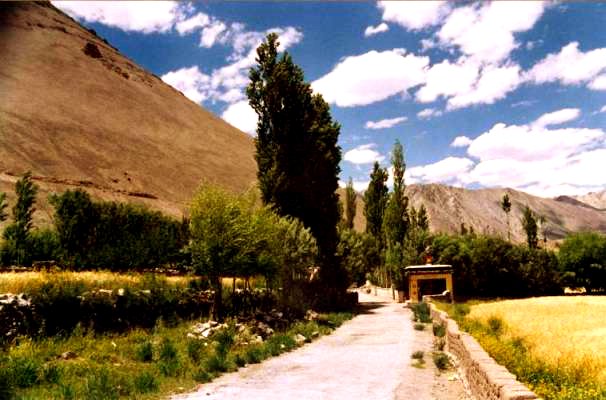
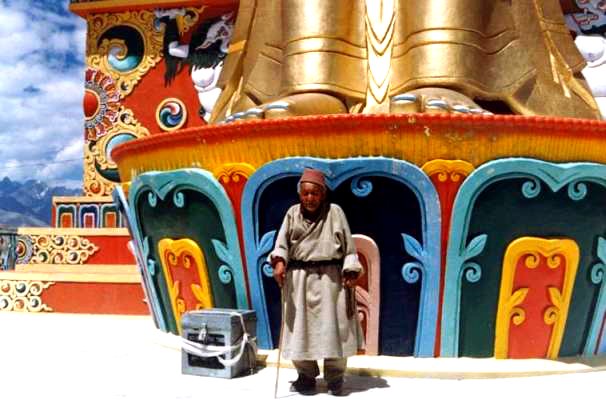
Passing through Nimo we arrived at a sleepy little hamlet known as Basgo. Overlooking it were the ruins of a huge fort perched atop a hill. By passing Basgo we headed along the Leh-Kargil highway for Likir Monastery, distinguished by its pyramidal structure. Presiding over a corner of the religious edifice was a massive image of Buddha. Entering the place, we explored its treasures - rare Buddhist and Ladakhi artifacts. The lamas there were kind enough to escort us around and provide us with a running commentary on the exhibits, but frankly, much of it went above our heads, although we were too polite to say so.
A treat awaited us on the rooftop, however. From that vantage point, the valley below, dotted with little houses and stupas, spread out like a carpet of green curling into the folds of bare hills that seemed to rear up against the horizon. And we lingered there longer than was strictly necessary, feasting our eyes on a sight we wouldn’t come across in our own city. It was with great reluctance that we resumed our journey left towards Kargil. At the village of Saspol, we turned right towards Alchi. In a short while, we were making our way through the beautiful village down road lined with poplars. The 11th century Alchi Monastery stood in solitary splendor, in the midst of a cluster of apricot trees. Built in sections, oe adjacent to the other and not in pyramidal style that is that is typical of Buddhist monasteries, this place of worship was abandoned centuries ago, but is maintained by the monks of Likir, the nearest functioning monastery.
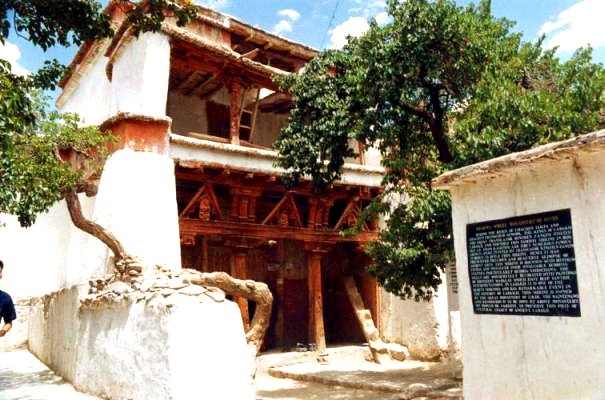 Its piece de resistance, turned out, however, to be its collection of paintings. The walls of each of the five section of this religious edifice were covered with the most exquisite murals, which, surprisingly enough, diverged from the style of those found in monasteries throughout Ladakh and the Himachal region. In fact, we detected a striking resemblence between Alchi murals and those found in of Maharashtra’s Ajanta Caves. Alchi Monastery, which housed classic examples of Kashmiri Buddhist art distinct from Tibetan, was in fact, the only repository of this form of art apart from certain buildings in Tabo in the Spiti region of Himachal Pradesh and in some sections of Phugtal in Zanskar, Ladakh. Its piece de resistance, turned out, however, to be its collection of paintings. The walls of each of the five section of this religious edifice were covered with the most exquisite murals, which, surprisingly enough, diverged from the style of those found in monasteries throughout Ladakh and the Himachal region. In fact, we detected a striking resemblence between Alchi murals and those found in of Maharashtra’s Ajanta Caves. Alchi Monastery, which housed classic examples of Kashmiri Buddhist art distinct from Tibetan, was in fact, the only repository of this form of art apart from certain buildings in Tabo in the Spiti region of Himachal Pradesh and in some sections of Phugtal in Zanskar, Ladakh.
Despite such claims to fame, we found the monastery in a lamentable state of desrepair. Damp have obliterated a number of murals beyond redemption. What truly saddened us, though, were the new paintings that had replaced the damaged ones. In neither form, colour nor spirit did they bear any resemblance to the fine old paintings that time and the elements had wiped out forever. Although the lamas of Likir have bee looking after the monastery for ages, restoration work requires
professional expertise. The irony of it all was that a sign, installed by the Archeological Survey of India, proudly proclaimed the monastery to be a “National Heritage.” Ther was precious little effort to cherish it, though.
Having admired the paintings within the monastery by shinning our flashlights on them (there was no source of illumination inside), we bade farewell to the last vestiges of Kashmiri Buddhist art with a feeling of finality. The way things were at Alchi, this precious heritage would, we suspected, be lost to posterity in the not-too-distant future. |